Ny Gounds for Family Court Order of Protection
We already know that human rights are inalienable rights possessed past every man, but how can nosotros admission these rights? Where can nosotros find evidence that these rights have been formally recognised by states? And how are these rights implemented?
Domestic Human being Rights
It goes without proverb that human rights protections and understandings are ultimately most reliant on developments and mechanisms at the national level. The laws, policies, procedures and mechanisms in place at the national level are cardinal for the enjoyment of human rights in each country. It is therefore crucial that man rights are function of the national constitutional and legal systems, that justice professionals are trained about applying man rights standards, and that human rights violations are condemned and sanctioned. National standards take a more direct bear on and national procedures are more accessible than those at the regional and international levels. As Eleanor Roosevelt observed:
Where, later on all, practise universal human rights begin? In pocket-sized places, shut to dwelling – so close and so small that they cannot exist seen on whatever map of the world. Nevertheless they are the world of the private person: the neighborhood he lives in; the school or college he attends; the manufacturing plant, farm or role where he works. Such are the places where every human, woman, and child seeks equal justice, equal opportunity, equal dignity without discrimination. Unless these rights have meaning at that place, they have lilliputian pregnant anywhere.ii
The duty of the State to respect, promote, protect and fulfil rights is therefore main, and that of regional or international tribunals subsidiary, coming into play mainly where the land is deliberately or consistently violating rights. We all know examples of how resort to regional and international mechanisms has become necessary for the acknowledgement that violations are occurring at the national level. Regional and international business or assistance may be the trigger for securing rights domestically, merely that is simply washed when all domestic avenues have been utilised and exhausted. It is for this reason that we dedicate the rest of this section to exactly this scenario. What resort is there where domestic systems have failed to ensure acceptable protection for the enjoyment of human rights?
Question: Why do you retrieve that fifty-fifty states with a very poor record on human being rights are set to sign international homo rights treaties?
Man rights are recognised by agreements
At the international level, states accept come together to describe up sure agreements on the field of study of human rights. These agreements establish objective standards of behaviour for states, imposing on them sure duties towards individuals. They tin can be of two kinds: legally bounden or non-bounden.
A binding document, oft called a Treaty, Convention or Covenant, represents a voluntary commitment by states to implement human rights at the national level. States individually commit to being spring by these standards through ratification or accession (just signing the document does not make it binding, although it represents the willingness to facilitate this). States can brand reservations or declarations in line with the 1969 Vienna Convention on the Police of Treaties, which exempt them from certain provisions in the certificate, the idea being to go as many of them as possible to sign. Later on all, information technology is amend to have a state promising to comply with some human rights provisions than with none! This mechanism, however, can sometimes be abused and used equally a pretext for denying basic man rights, allowing a state to "escape" international scrutiny in certain areas.
Human rights take, however, likewise permeated binding law at the national level. International human rights norms have inspired states to enshrine such standards into national constitutions and other legislation. These may also provide avenues for redress for human rights violations at the national level.
By contrast, a non-binding musical instrument is basically just a annunciation or political understanding by states to the effect that all attempts will be fabricated to come across a set of rights but without whatever legal obligation to do so. This usually means, in practice, that there are no official (or legal) implementation mechanisms although at that place may be strong political commitments to accept them.
Question: What is the value in a mere "promise" to abide past human being rights standards, when this is not backed upward by legal mechanisms? Is it meliorate than nothing?
Meetings of the United nations Full general Assembly or United nations conferences held on specific issues frequently effect in a United Nations declaration or non-binding document besides referred to as "soft law". All states, merely by existence members of the Un or by taking part in the conference, are considered to be in agreement with the annunciation issued. The recognition of homo rights should also, at the national level, be the effect of an understanding between a state and its people. When man rights are recognised at the national level, they become primarily a political delivery of a state towards its people.
Key international documents
The importance of human rights is increasingly being acknowledged through wider instruments offering such protection. This should be seen as a victory non only for human being rights activists, but for people in general. A corollary of such success is the development of a large and complex body of human rights texts (instruments) and implementation procedures.
Human rights instruments are normally classified nether three primary categories: the geographical telescopic (regional or universal), the category of rights provided for and, where relevant, the specific category of persons or groups to whom protection is given.
At the UN level alone, in that location are more than a hundred human rights related documents, and if we add in those at different regional levels, the number increases further. We cannot consider all these instruments here, so this section will only deal with those that are most relevant for the purpose of human rights teaching in Compass:
- documents which have been widely accustomed and have laid the ground for the development of other man rights instruments, most particularly the International Bill of Rights. (For more specific instruments, such as the Refugee Convention, Genocide Convention and instruments addressing International Humanitarian Law, please refer to the thematic sections of Affiliate 5.)
- documents relating to specific problems or beneficiaries, which are explored in this manual
- the major European documents.
United Nations Instruments
The most important global human being rights musical instrument is the Universal Declaration of Human Rights, adopted in 1948 past the Full general Assembly of the UN. This is and so widely accepted that its initial non-bounden character has altered, and much of information technology is now frequently referred to as legally binding on the basis of customary international police. Information technology is the touchstone human rights instrument from which tens of other international and regional instruments, and hundreds of domestic constitutions and other legislation, has drawn inspiration.
The UDHR consists of a preface and 30 articles setting along the human being rights and fundamental freedoms to which all men and women everywhere in the world are entitled, without whatsoever discrimination. It encompasses both civil and political rights as well every bit social, economical and cultural rights:
- Right to Equality
- Liberty from Discrimination
- Right to Life, Freedom, Personal Security
- Liberty from Slavery
- Liberty from Torture and Degrading Treatment
- Correct to Recognition as a Person before the Law
- Right to Equality earlier the Police
- Correct to Remedy by Competent Tribunal
- Liberty from Arbitrary Arrest and Exile
- Right to Fair Public Hearing
- Correct to be Considered Innocent until Proven Guilty
- Freedom from Interference with Privacy, Family, Domicile and Correspondence
- Correct to Costless Movement in and out of the Land
- Right to Asylum in other Countries from Persecution
- Right to a Nationality and the Freedom to Change it
- Correct to Wedlock and Family unit
- Correct to Ain Belongings
- Freedom of Belief and Faith
- Freedom of Opinion and Information
- Right of Peaceful Assembly and Association
- Right to Participate in Government and in Gratuitous Elections
- Right to Social Security
- Right to Desirable Work and to Bring together Trade Unions
- Right to Rest and Leisure
- Right to Acceptable Living Standard
- Right to Education
- Right to Participate in the Cultural Life of Customs
- Right to a Social Order that Articulates the UDHR
The Declaration as well contains a strong reference to customs and citizenship duties as essential to free and full development and to respecting the rights and freedoms of others. Similarly, the rights in the declaration cannot be invoked past people or states in violating human rights.
The International Covenant on Civil and Political Rights (ICCPR) and the International Covenant on Economic, Social and Cultural Rights (ICESCR) both came into force in 1976 and are the main legally binding instruments of worldwide application. The 2 Covenants were drafted in order to expand on the rights outlined in the UDHR, and to give them legal force (within a treaty). Together with the UDHR and their respective Optional Protocols, they form the International Nib of Rights. Each of them, equally their names bespeak, provides for a different category of rights although they also share concerns, for example in relation to non-discrimination. Both instruments have been widely ratified, with the ICCPR having 166 ratifications and the ICESCR 160 ratifications, as of November 2010.
Further to the International Nib of Rights, the Un has adopted a further vii treaties addressing particular rights or beneficiaries. At that place has been mobilisation for the idea of detail rights or beneficiaries – for instance child rights for children – as despite the application of all human rights to children and immature people, children are not seen to savour equal access to those full general rights and they are in need of specific additional protections.
The Convention on the Rights of the Child (1989) recognises that children have human rights too, and that people under the age of 18 need special protection in society to ensure that their full development, their survival, and their best interests are respected.
The International Convention on the Elimination All Forms of Racial Discrimination (1965) prohibits and condemns racial discrimination and requires states parties to take steps to bring it to an end by all appropriate ways, whether this is carried out by public authorities or others.
The Convention on the Elimination of All Forms of Bigotry Against Women (CEDAW, 1979) focuses on the discrimination which is frequently systemically and routinely suffered by women through "distinction, exclusion or restriction made on the footing of sex which has the effect or purpose of impairing or nullifying the recognition, enjoyment or practise past women […] of man rights and fundamental freedoms in the political, economic, social, cultural, civil, or any other field". (Commodity 1) States undertake to condemn such discrimination and accept immediate steps to ensure equality.
The Convention Against Torture and Other Forms of Cruel, Inhuman or Degrading Treatment (1984) defines torture as "astringent pain or suffering, whether concrete or mental" (Commodity ane.1), which is intentionally inflicted in order to obtain information, as penalization or coercion or based on discrimination. This treaty requires states parties to take effective measures to prevent torture within their jurisdiction and forbids them from returning people to their abode state if there is reason to believe they would exist tortured there.
The Convention on the Protection of the Rights of Migrant Workers and members of their Families (1990) refers to a person who "is to be engaged, is engaged or has been engaged in a remunerated activity in a State of which he or she is not a national" (Article 2.1), and to members of his/her family. As well as delineating the general human rights which such people should benefit from, the treaty clarifies that whether documented and in a regular and legal situation or not, discrimination should not be suffered in relation to the enjoyment of rights such as freedom and security, protection against violence or deprivation of freedom.
The Convention on the Rights of Persons with Disabilities marks a groundbreaking shift not only in its definition of people with disabilities merely also in their recognition equally equal subjects with full and equal human rights and fundamental freedoms. The treaty clarifies the awarding of rights to such people and obliges states parties to make reasonable adaptation for people with disabilities in order to permit them to exercise their rights effectively, for example in society to ensure their admission to services and cultural life.
The Convention on Enforced Disappearances addresses a phenomenon which has been a global trouble. The treaty prohibits the "arrest, detention, abduction or whatsoever other form of impecuniousness of liberty" (Article 2), whether by state agents or others interim with the states' acquiescence followed by a refusal to acknowledge the deprivation of liberty or by concealment of the fate or whereabouts of the disappeared person. Information technology states that no exceptional circumstances any for this refusal to acknowledge impecuniousness of liberty and the concealment of the fate and whereabouts of victims. Its objective is to terminate this cynical ploy and attempt to inflict serious human rights violations and get away with it.
| Major United Nations' Human Rights Treaties | ||
| Treaty | Monitored by | Optional Protocols |
| International Convention on the Elimination of Racial Discrimination (1965) | Committee on the Emptying of Racial Discrimination | |
| International Covenant on Civil and Political Rights (1966) | Man Rights Commission | Starting time Optional Protocol establishing an private complaint mechanism 2nd Optional Protocol aiming at the abolition of the death penalty |
| International Covenant on Economic, Social and Cultural Rights (1966) | Committee on Economic, Social and Cultural Rights | Optional Protocol recognising the Commission'due south competence to receive communications submitted by individuals or groups (2008) |
| Convention on the Rights of the Child (1989) | Committee on the Rights of the Child | Optional Protocol on the involvement of children in Armed Conflict (2000). Optional Protocol on the sale of children, kid prostitution and child pornography (2000). Optional Protocol assuasive children to bring complaints directly to the Committee (2011). |
| Convention on the Emptying of All Forms of Discrimination Against Women (1979) | Commission on the Elimination of Bigotry Against Women | Optional Protocol on the right to individual complaints |
| Convention Confronting Torture and Other Forms of Savage, Inhuman or Degrading Treatment (1984) | Committee confronting Torture | Optional Protocol establishing a organisation of regular visits past independent international and national bodies - monitored by the Subcommittee on Prevention (2002) |
| Convention on the Protection of the Rights of Migrant Workers and members of their Families (1990) | Committee on the Protection of the Rights of Migrant Workers and members of their Families | |
| The Convention on the Rights of Persons with Disabilities (2006) | Committee on the Rights of Persons with Disabilities | Optional Protocol on Communications allows individuals and groups to petition the Committee. |
| The Convention on Enforced Disappearances (2006) | Committee on Enforced Disappearances | |
Protection of specific groups at the United nations and European levels
As well as recognising the cardinal rights of individuals, some human rights instruments recognise the rights of specific groups. These special protections are in identify considering of previous cases of discrimination against groups and because of the disadvantaged and vulnerable position that some groups occupy in society. The special protection does non provide new human rights as such but rather seeks to ensure that the human rights of the UDHR are effectively accessible to anybody. It is therefore wrong to pretend that people from minorities have more than rights than people from majorities; if in that location are special rights for minorities, it is simply to guarantee them equality of opportunities in accessing ceremonious, political, social, economic or cultural rights. Examples of groups that have received special protection are:
Minorities
Minorities accept not been definitively defined by international human rights instruments, but they are unremarkably described in such instruments as those with national or ethnic, religious or linguistic characteristics that differ from the majority population and which they wish to maintain. These are protected:
- at the United nations level by article 27 of the International Covenant on Civil and Political Rights as well as by the Proclamation on the Rights of Persons Belonging to National or Ethnic, Religious and Linguistic Minorities adopted in 1992
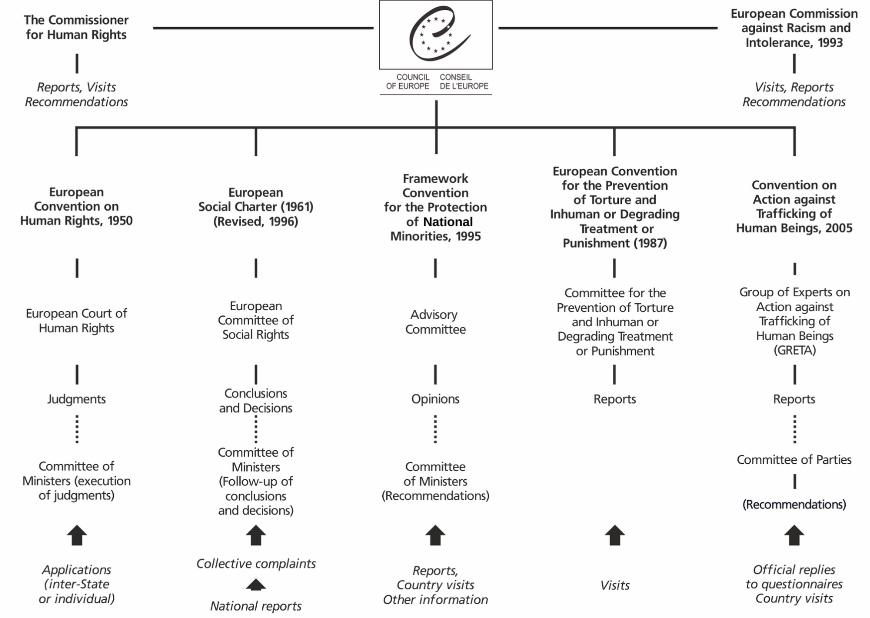
- at the European level past a binding musical instrument – the Framework Convention for the Protection of National Minorities (FCNM), which created a monitoring body of independent experts: the Advisory Committee on the FCNM. Other Council of Europe sectors have activities relevant to the protection of minorities: the European Charter for Regional or Minority Languages, the European Commission Against Racism and Intolerance (ECRI), and the Commissioner for Human being Rights, amongst others, are instrumental in this.
- by having a special identify in the Arrangement for Security and Co-operation in Europe (OSCE) by the Loftier Commissioner on National Minorities, and by relevant OSCE documents.
Children
Their main protection is given at the UN level with the Convention on the Rights of the Kid (CRC) of 1989, the most widely ratified convention (not ratified only by the United states of america). The Convention's four core principles are: non-discrimination; a commitment to upholding the all-time interests of the child; the right to life, survival and development; and respect for the views of the child.
At the African level, the African Charter on the Rights and Welfare of the Child provides basic children's rights, taking into business relationship the unique factors of the continent'due south situation. It came into force in 1999. The Covenant of the Rights of the Child in Islam was adopted past the Organisation of Islamic Conference in 2005. The ASEAN Commission on the Promotion and Protection of the Rights of Women and Children was inaugurated in April 2010.
The Council of Europe Convention on the Protection of Children confronting Sexual Exploitation and Sexual Abuse came into force on 1 July 2010. This Convention is the first instrument to establish the various forms of sexual abuse of children as criminal offences, including such abuse committed in the home or family.
Refugees
The rights of refugees are specially guaranteed in the Convention relating to the Status of Refugees of 1951 and past the United nations High Commissioner on Refugees (UNHCR). The only regional arrangement with a specific instrument on refugee protection has been Africa with the adoption, in 1969, of the Convention Governing the Specific Aspects of Refugee Bug in Africa, but in Europe the ECHR as well offers some protection.
Women
In social club to promote worldwide equality between the sexes, the rights of women are specifically protected by the UN Convention on the Elimination of All Forms of Bigotry confronting Women (CEDAW), 1979.
In the Council of Europe, 2009 saw the adoption of the Declaration: Making Gender Equality a Reality. The adoption of this Declaration marked xx years after the adoption of some other Declaration on the equality of Women and Men. The aim of the 2009 Declaration is to bridge the gap between the equality of genders in fact, as well equally in police force. It calls on Member States to eliminate structural causes of power imbalances betwixt women and men, ensure economic independence and empowerment of women, address the need to eliminate established stereotypes, eradicate violations of the nobility and human rights of women through effective activity to prevent and combat gender-based violence, and the integration of a gender equality perspective in governance.
Others
Groups such as people with disabilities are also given special protection because of their vulnerable position, which tin brand them more than prone to corruption. This is established in the UN Convention on the Rights of Persons with Disabilities, which will exist discussed further in Chapter 5.
Other groups too, for instance indigenous peoples, take also received specific protection at the international level through the 2007 United nations Announcement on the Rights of Indigenous Peoples, although not notwithstanding as a legally bounden instrument.
Question: Are in that location other groups in your society that are in need of special protection?
Regional instruments
Every bit we tin can encounter above, international and regional instruments generally uphold the same minimum standards but they may differ in their focus or in raising regionally focused concerns. For example, the concern with internally displaced persons was spearheaded in the African region before the issue actually emerged as a matter for United nations business organisation; similarly, the machinery of visiting places of detention in an try to prevent torture was first established at the European level before an Optional Protocol allowed for the same mechanism nether the United nations Convention Against Torture. These examples bear witness how regional and international norms and mechanisms tin can enhance the promotion and protection of human rights.
The practical reward of having regional human rights norms and systems for the protection of homo rights is that they are more probable to accept been crafted in the basis of closer geographic, historical, political, cultural and social affinities. They are closer to 'habitation' and are more likely to enjoy greater support. They are also more accessible to policy makers, politicians and victims. We may therefore see them equally the 2d 'front' for the upholding of human rights, the first being domestic, the second regional and the third international.
Iv of the five globe regions have established man rights systems for the protection of human being rights. The objective of regional instruments is to clear man rights standards and mechanisms at the regional level without downgrading the universality of homo rights. Every bit regional systems have developed, whether due to an economic impetus or for more historical or political reasons, they have also felt the urge to clear a regional human rights delivery, often reinforcing the mechanisms and guarantees of the UN system. Indeed at that place have been many examples where regional standards exceed internationally agreed standards, one example being the African system's pioneering recognition of the demand for protection, not only for refugees but besides for internally displaced persons.
In the Americas, there is the Organization of American States, and the principal bounden document is the American Convention on Human Rights of 1969.
In Africa, nosotros find the African Charter on Human and Peoples' Rights, adopted in 1986 within the African Matrimony (formerly known every bit the Organisation of African Unity).
On the Asian continent, no existent system has been developed to date and the just regional human rights instrument is a non-binding 1998 peoples' charter initiated by civil club – the Asian Declaration on Man Rights.
European instruments
Europe has a well-established organisation inside the Council of Europe for the protection of human rights of which the cornerstone is the European Convention on Human Rights with its European Courtroom of Human Rights based in Strasbourg.
Question: Why do yous think different regions have establish it necessary to establish their ain human being rights systems?
The Quango of Europe, with its 47 fellow member states, has played a key part in the promotion of human rights in Europe. Its main man rights instrument is the European Convention on the Protection of Human Rights and Central Freedoms (also known equally the European Convention on Human being Rights-ECHR). This has been accustomed past all the member states in the Quango of Europe, since it is a requirement for membership. It was adopted in 1950 and came into force iii years later. It provides for civil and political rights and its master strength is its implementation mechanism, the European Court of Homo Rights. This court and its jurisprudence are admired throughout the world and are often referred to past the UN and by ramble courts of numerous countries and other regional systems.
Just as at the UN level, social and economical rights in Europe are provided for in a divide certificate. The (Revised) European Social Lease is a bounden document that covers rights to safeguard people'southward standard of living in Europe. The lease has been signed past 45 fellow member states and, by 2010, it had been ratified by 30 of them.
In addition to these two major instruments, the Council of Europe's action in the field of human rights include other specific instruments and conventions that complement the guarantees and provisions of the ECHR by addressing specific situations or vulnerable groups. Conventional monitoring systems are complemented by other contained bodies such as the European Commission confronting Racism and Intolerance and the Commissioner for Homo Rights. Altogether, the work of the Council of Europe for homo rights should exist able to take into account social, scientific and technological developments, and the possible new challenges that they nowadays for human rights.
Homo Rights Development
Human rights instruments are a record of our latest understandings of what human dignity requires. Such instruments are likely to be always one step behind, in that they are addressing challenges that accept already been acknowledged rather than those that remain so institutionalised and embedded in our societies that we still fail to acknowledge them every bit rights and rights violations.
In the Council of Europe, the standard-setting work of the organization seeks to advise new legal standards to respond to social measures to bargain with problems arising in the fellow member States apropos issues within their competence to the Committee of Ministers. These measures may include proposing new legal standards or adapting existing ones. This is how the procedures of the European Court of Man Rights are evolving so that it remains effective, how provisions for abolishing the death sentence have been adopted, and how new convention-based instruments, such as the Convention on Action against Trafficking of Human Beings, adopted in 2005, have come up to light.
In this sense, human being rights instruments volition go along to be revised and advanced for time immemorial. Our understanding, case law and – most of all – our advocacy will continue to push, pull and stretch human rights continuously. The fact that the provisions of human rights conventions and treaties are sometimes seen every bit being beneath what we would sometimes expect should non be a reason to question what human rights represent as promise for humanity. Human rights law will often remain backside what human rights advocates would look, just it as well remains their most reliable back up.
Main human rights instruments and implementation mechanisms of the Quango of Europe
Fighting racism and intolerance
All human rights instruments contain non-discrimination and equality guarantees, whether they are United nations, Council of Europe, EU or OSCE standards. At the UN level, the International Convention on the Elimination of All Forms of Racial Discrimination came into force in 1969 and is monitored by an expert torso, the Commission on the Elimination of Racial Discrimination. The Committee receives and reviews state reports regarding compliance with the treaty, has an early warning procedure aimed at preventing situations fuelled by intolerance that may escalate into conflict and serious violations of the Convention, and a procedure for receiving private complaints where the state concerned has allowed for this. The European Union's Race Directive, in turn, applies to employment and to the provision of goods and services by the Country and private actors.
The European Commission Against Racism and Intolerance (ECRI) is a mechanism of the Council of Europe. Established in 1993, ECRI'southward task is to gainsay racism, xenophobia, anti-semitism and intolerance at the level of Europe as a whole and from the perspective of the protection of man rights. ECRI'due south action covers all necessary measures to combat violence, discrimination and prejudice faced by persons or groups of persons, notably on grounds of race, colour, language, religion, nationality and national or ethnic origin.
ECRI'due south members are designated by their governments on the ground of their in-depth knowledge in the field of combating intolerance. They are nominated in their personal capacity and human activity as independent members.
ECRI's main programme of activities comprises:
- a country-past-country approach consisting of carrying out in-depth analyses of the state of affairs in each of the fellow member countries in gild to develop specific, concrete proposals, matched by follow-up
- work on general themes (the collection and apportionment of examples of good exercise on specific subjects to illustrate ECRI'due south recommendations, and the adoption of general policy recommendations)
- activities in liaison with the community, including awareness-raising and information sessions in the member states, co-ordination with national and local NGOs, communicating an anti-racist bulletin and producing educational material.
Protocol 12 of the European Convention on Man Rights
An additional protocol to the ECHR was adopted in 2000 and entered into force in 2005; this was Protocol 12. As of early 2011 it has been signed past 19 states and ratified past 18. Its primary focus is the prohibition of discrimination.
The ECHR already guarantees the right not to be discriminated against (Article 14) simply this is thought to exist inadequate in comparing with those provisions of other international instruments such as the UDHR and the ICCPR. The main reason is that commodity 14, unlike the others, does non contain an contained prohibition of discrimination; that is, it prohibits discrimination only with regard to the "enjoyment of the rights and freedoms" set along in the Convention. When this protocol came into forcefulness, the prohibition of discrimination gained an 'independent life' from other provisions of the ECHR. The Court found a violation of this provision for the first time in 2009 in Sejdić and Finci v. Bosnia and Herzegovina (GC, nos. 27996/06 and 34836/06, 22 December 2009).
Enforcing human rights
How can we ensure that these protection mechanisms work? Who or what compels states to carry out their obligations?
At a national level, this work is carried out by courts – when man rights instruments have been ratified or incorporated into national law – merely as well, depending on the country, by ombudsman offices, human rights committees, homo rights councils, parliamentary committees, and so on.
The main international supervisory bodies are commissions or committees and courts, all of which are composed of independent members – experts or judges – and none of whom represent a single state. The chief mechanisms used by these bodies are:
- Complaints (brought by individuals, groups or states)
- Court cases
- Reporting procedures.
Since not all human being rights instruments or regional systems use the aforementioned procedures for implementing human rights, a few examples will help to analyze.
Complaints
Complaints confronting a state are brought before a commission or committee in what is commonly referred to equally a quasi-judicial procedure. The supervisory trunk and so takes a conclusion and states are expected to comply with it, though no legal enforcement procedure exists. Often a state needs to requite an boosted declaration or ratification of an optional protocol to signify its credence of the complaints system. The Homo Rights Committee (or "ICCPR Committee") and the Commission on the Elimination of Racial Discrimination (within the United Nations organisation), and the Inter-American Commission on Human being Rights (inside the Organisation of American States) are examples of bodies dealing with such complaints.
Question: What sanctions could exist if we established an International Man Rights Court?
Court cases
And so far there are iii permanent regional courts which exist equally supervisory bodies specifically for the implementation of human rights: the European Courtroom of Homo Rights, the Inter-American Court of Human being Rights and the African Court of Justice and Homo Rights (ACJHR). The Inter-American Court of Human being Rights was established by the Organization of American States in 1979 to interpret and enforce the American Convention on Human Rights. The African Courtroom is the most recent of the regional courts, having come into being in Jan 2004. It decides cases in compliance with the African Charter on Human being and Peoples' Rights in relation to state members of the African Marriage. Based in Arusha, Tanzania, the Court'due south judges were elected in 2006 and information technology delivered its outset judgment in December 2009, declaring it had no jurisdiction to hear the case Yogogombaye 5 Senegal.
Later ratification of the Rome Statute by 60 countries, the first permanent international criminal court came into force in 2002 to attempt cases related to war crimes, crimes against humanity and genocide. This International Criminal Court (ICC) tries individuals accused of crimes against humanity, genocide and war crimes but only if national courts are unwilling or unable to investigate or prosecute these crimes. To engagement the ICC has investigated v situations in Northern Uganda, the Democratic Republic of the Congo, the Central African Republic, Sudan (Darfur) and Kenya. Its groundbreaking case law has helped advance man rights understandings, for case in relation to the incitement of genocide and the right to gratuitous and fair elections.
The International Court of Justice (ICJ) is the principal judicial organ of the United nations. It has a dual role: to settle in accordance with international law the legal disputes submitted to it by states, and to give advisory opinions on legal questions. Only states can bring a instance confronting some other land and usually the cases are to practice with treaties between states. These treaties may concern basic relations between states, (for example commercial or territorial) or may chronicle to human rights issues. The ICJ does not allow individuals to bring human rights or other claims to it. It has, however, contributed to furthering man rights past interpreting and developing human rights rules and principles in cases which states or international bodies have brought to information technology. It has addressed rights such as self-decision, non-bigotry, freedom of motion, the prohibition of torture, and then on.
There is ofttimes confusion surrounding the roles of the European Court of Human being Rights (ECHR), the European Court of Justice (ECJ) and the International Court of Justice (ICJ). In bodily fact, the iii bodies are very different in terms of their geographical jurisdiction and the types of cases they examine.
The ECJ is a body of the European Wedlock. This is a court whose master duty is to ensure that Community constabulary is not interpreted and applied differently in each member state. It is based on Community law and not human rights law; only sometimes Community law may involve human rights bug.
The International Courtroom of Justice (ICJ) is the principle judicial organ of the United nations and its office was discussed higher up.
The European Court of Human Rights
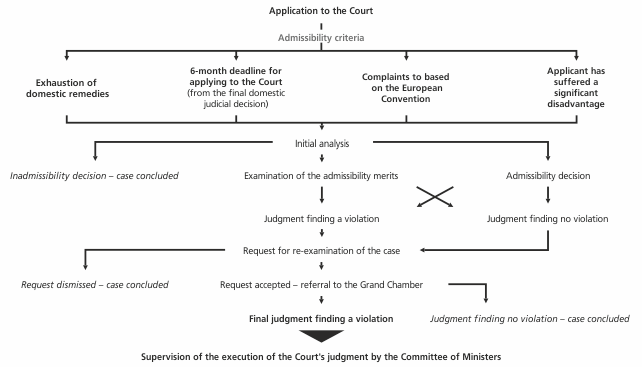
The European Court of Man Rights in Strasbourg is famous for a number of reasons, but perhaps above all, considering it gives life and meaning to the text of the ECHR. I of its master advantages is the system of compulsory jurisdiction, which means that as soon as a state ratifies or accedes to the ECHR, information technology automatically puts itself under the jurisdiction of the European Court. A human being rights example can exist brought against the State Political party from the moment of ratification.
Another reason for its success is the forcefulness of the Court'due south judgment. States take to comply with the final judgment. Their compliance is supervised by the Committee of Ministers of the Council of Europe.
In every example brought earlier the European Court, the procedure as well includes the possibility of having a friendly settlement based on mediation between the parties. The Courtroom has been able to develop over fourth dimension. When it was initially fix upward in 1959, information technology was merely a part-fourth dimension courtroom working together with the European Commission of Human Rights. With the increase of cases, a full-fourth dimension court became necessary and one was gear up up in November 1998. This increase in the number of cases is clear testify of the Courtroom'southward success, simply this workload is also jeopardising the quality and effectiveness of the system. People know that the Court is there and able to footstep in when they feel their primal rights are being infringed; even so, the authority and effectiveness of the ECHR at the national level should be ensured, in accordance with the "principle of subsidiarity", which foresees that states have chief responsibility to prevent man rights violations and to remedy them when they occur.
Proceedings before the European Court of Human Rights
Some allegorical cases of the European Courtroom of Human Rights
- Soering v. the Britain (June 1989): This was a instance involving a man who was to be extradited to US to face charges of murder, where the offense was punishable by the death penalty. The Court took the view that to send him back to the US would exist confronting the prohibition of torture, inhuman or other degrading treatment or penalization (Article 3, ECHR). 1 consequence of this decision was that the protection of individuals within a fellow member land of the Council of Europe went beyond European borders. This principle has already been followed in other cases, such as Jabari v. Turkey (July 2000), and has protected asylum seekers from beingness sent back to a land where they would have their lives endangered.
- Tyrer v. the Uk (March 1978): In this case, the Court considered that corporal penalty as a punishment for juvenile offenders was against the ECHR because it violated the right not to be tortured or to have degrading and inhuman treatment or punishment, as guaranteed under Article 3. In the Court's words: "his penalization – whereby he was treated every bit an object in the power of the authorities – constituted an assault on precisely that which it is one of the main purposes of Commodity 3 (Fine art. 3) to protect, namely a person's nobility and concrete integrity". This case is a good case of the living nature of the ECHR, where the Court keeps footstep with the irresolute values of our guild.
- Kokkinakis five. Greece (April 1993): This was an interesting case, which dealt with the conflict between the rights of different people. It was based on the issue of proselytising and whether the instruction of a religion (guaranteed nether article 9 of ECHR) violates another person's right to freedom of religion. The courtroom idea it necessary to brand a clear distinction between educational activity, preaching or discussing with immoral and deceitful means to convince a person to change his/her religion (such every bit offer material or social advantages, using violence or brainwashing).
- DH 5 Czech republic (November 2007): This was a case taken by xviii Roma children in the light of the fact that Roma students were segregated into special schools for children with learning disabilities, regardless of their power. This meant that they would also have little chance in after accessing higher education or job opportunities. In its judgment, the Court for the first time found a violation of article 14 (prohibition of bigotry) in relation to a "pattern" of racial discrimination in a item sphere of public life, in this case public schools. The Court ruled that this systemic pattern of racial segregation in schooling violated not-discrimination protections in the ECHR (Article fourteen). It also noted that a general policy or measure, couched in neutral terms, may still discriminate against a particular group and result in indirect discrimination against them. The example was a offset in challenging systemic racial segregation in instruction.
Question: Practise you know of any important cases confronting your state at the European Court of Human Rights?
Reports and reviews
The majority of human being rights instruments require states to submit periodic reports. These are compiled by states post-obit the directions of the supervisory body. The objective of such reporting, and the subsequent review with the corresponding monitoring torso, is a frank exchange of challenges being faced in efforts towards the realisation of the rights concerned. The reports are publicly examined in what is referred to as the 'state dialogue'. The state reports are examined aslope any NGO 'shadow reports', based on their own sources and analysis, addressing the tape of that state. Subsequently the dialogue betwixt state representatives and independent expert members of the monitoring trunk, that torso issues its observations regarding the compliance of that state with the standards upheld in the binding instrument under review. These observations address both positive and critical aspects regarding the country's record. The ICCPR, ICESCR, and the Convention on the Elimination of All Forms of Discrimination against Women (CEDAW) are examples of instruments requiring the submission of such periodic reports.
As well as this state dialogue procedure, monitoring bodies may also be empowered to acquit out 'in situ' or field visits to observe the situation of human rights first hand. Most such visits require the explicit permission of the country on a instance-by-case basis. However, efforts are being made to allow for open continuing invitations, for instance with states publicly issuing standing invitations for visits by any Un Special Mandate holders.
More robust procedures accept also been developed under a number of instruments to allow for intrusive ongoing visits, in the effort not but to reply to, simply also to prevent, violations of man rights.
The European Convention for the Prevention of Torture and Inhuman or Degrading Treatment or Penalty (1987) offers ane such example. It is based on a system of visits by members of the European Committee for the Prevention of Torture and Inhuman or Degrading Treatment or Punishment (CPT) to places of detention, for case prisons and places of youth detention, law stations, army barracks and psychiatric hospitals. Members of the CPT detect how detainees are treated and, if necessary, recommend improvements in order to comply with the right non to be tortured or to be inhumanly treated. This mechanism has since inspired the development of a similar UN mechanism. CPT delegations periodically visit states that are party to the Convention simply may organise boosted advert hoc visits if necessary. As of 9 Baronial 2012, the CPT had conducted 323 visits, and published 272 reports.
An of import part of the CPT's work was seen in the example of the hunger strikes in Turkish prisons in 2000-2001. When the Turkish government was cartoon upwards changes to the prison arrangement, a number of prisoners used hunger strikes to protest confronting some of the reforms. Their demonstrations became violent. The CPT became actively involved in negotiations with government and hunger strikers, investigating the events surrounding the hunger strikes and looking at how the draft laws could reform the Turkish prison organization. The CPT has visited Turkey every year since 1999, except in 2008. More contempo CPT visits have included those to Serbia, Albania and Greece.
The Quango of Europe Commissioner for Human Rights
The office of the Council of Europe Commissioner for Homo Rights was gear up in 1999. The purpose of this independent institution is both to promote the concept of homo rights and to ensure effective respect for and full enjoyment of these rights in Council of Europe member States. The Commissioner is elected by the Parliamentary Assembly for a non-renewable term of part of half-dozen years.
The Commissioner is a non-judicial institution whose action is to be seen as complementary to the other institutions of the Quango of Europe which are active in the promotion of human rights. The Commissioner is to behave out its responsibilities with complete independence and impartiality, while respecting the competence of the various supervisory bodies prepare up under the European Convention on Human Rights or nether other Council of Europe homo rights instruments.
The Commissioner for Human being Rights is mandated to:
- foster the effective observance of homo rights, and assist fellow member states in the implementation of Council of Europe man rights standards
- promote education in and awareness of human being rights in Council of Europe member states
- identify possible shortcomings in the law and practice apropos human rights
- facilitate the activities of national ombudsperson institutions and other human rights structures, and
- provide advice and information regarding the protection of homo rights across the region.
The Commissioner can deal ex officio with whatsoever issue within its competence. Although it may not take up private complaints, the Commissioner tin act on any relevant data concerning general aspects of the protection of man rights as enshrined in Council of Europe instruments.
Such information and requests to deal with information technology may exist addressed to the Commissioner by governments, national parliaments, national ombudsmen or like institutions, besides as by individuals and organisations. The Commissioner's thematic work has included the issuing of reports, recommendations, opinions and viewpoints on the human rights of asylum seekers, immigrants and Roma.
The Council of Europe Commissioner for Human Rights should not be confused with the United Nations Homo Rights Commissioner for human rights.
Many NGOs lobbied for the creation of the mail of the UN High Commissioner for Human Rights and the decision for its cosmos was agreed at the Un Globe Conference on Homo Rights in Vienna in 1993, which recommended that the General Assembly consider the question of establishing such a Loftier Commissioner for the promotion and protection of all homo rights as a matter of priority. This was washed in the same year.
The United Nations High Commissioner for Human Rights is appointed by the UN Secretarial assistant-General and approved by the General Assembly as a "person of loftier moral standing" with expertise in human rights as the UN official with primary responsibility for Un human being rights activities: their role includes the promotion, protection and effectively enjoyment of all rights, engagement and dialogue with governments on securing human rights, and enhancing international co-functioning and Un co-ordination for the promotion and protection of all human being rights. As the principal human being rights official of the UN, the High Commissioner's activities include the direction of the Office of the Loftier Commissioner for Man Rights (OHCHR) and its regional and country offices. The OHCHR supports the work of a broad range of United nations man rights activities and works for the promotion and protection of human rights and the enforcement of universal human rights norms, including the World Programme on Man Rights Education.
Is this sufficient?
Many people would argue that the poor human rights record in the earth is a result of the lack of proper enforcement mechanisms. It is often left up to private states to make up one's mind whether they carry out recommendations. In many cases, whether an private or grouping correct volition in fact be guaranteed depends on pressure level from the international community and, to a large extent, on the work of NGOs. This is a less than satisfactory situation, since information technology tin exist a long wait earlier a homo rights violation is really addressed past the United nations or the Council of Europe.
Can anything be done to change this? Firstly, it is essential to ensure that states guarantee human rights at national level and that they develop a proper mechanism for remedying whatever violation. At the same time, pressure must be put on states to commit themselves to those mechanisms that take enforcement procedures.
Notes
2 http://world wide web.united nations.org/en/globalissues/briefingpapers/humanrights/quotes.shtml
Source: https://www.coe.int/en/web/compass/legal-protection-of-human-rights
0 Response to "Ny Gounds for Family Court Order of Protection"
Post a Comment